Boiler Replacement in Mariners Harbor, Staten Island
Engineered heating upgrades, high-efficiency system sizing, and professional installation built for coastal Staten Island winters.
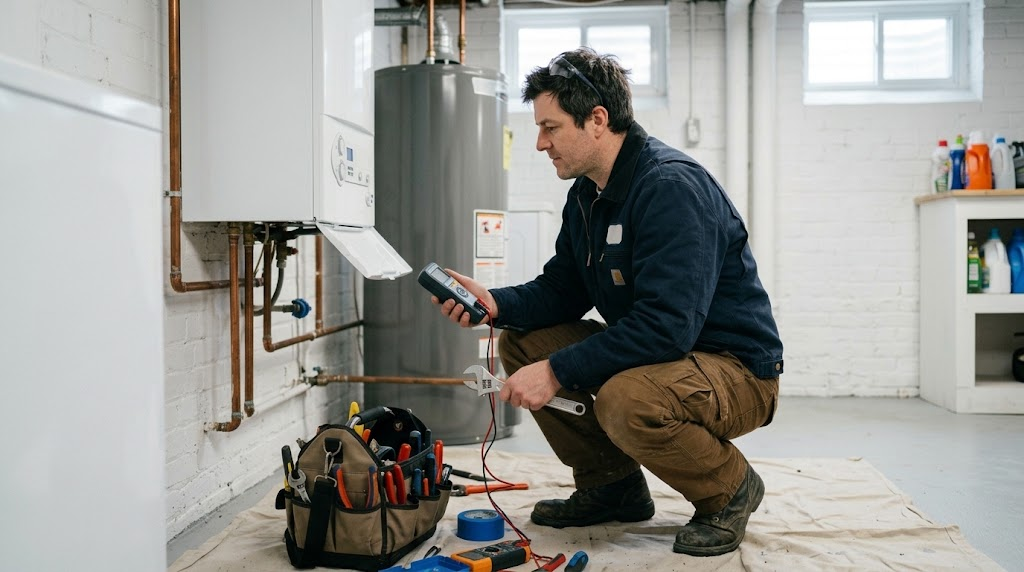
Precision Heating Sizing & System Engineering
Replacing an obsolete boiler is one of the most consequential structural improvements a homeowner can make in Mariners Harbor. Older wood-frame residences and post-war split-levels along Continental Place, Grandview Avenue, and South Avenue often contain oversized heating units installed decades ago. Oversized boilers waste fuel through frequent cycling, cause excessive thermal stress, and generate loud banging in distribution pipes.
Our installation process begins with rigorous mathematical load calculation. For hydronic hot water systems, we calculate building envelope heat loss using modern Manual J principles. For low-pressure steam systems, we calculate total Equivalent Direct Radiation (EDR) by measuring every radiator in your home. This precise engineering ensures your new boiler produces the exact volume of steam needed to satisfy radiator capacity without building unmanageable head pressure.
Upgrading to modern condensing or cast iron boiler equipment also delivers significant fuel economy improvements. Today's high-efficiency condensing boilers achieve up to 95% AFUE, condensing flue vapor to reclaim latent thermal energy that older atmospheric equipment vented up the chimney.
When to Choose Replacement Over Continued Repairs
While prompt repairs can resolve localized component failures, there is a clear threshold where continuous patching becomes financially counterproductive:
- Cracked Heat Exchanger: When cast iron sections fracture or internal water passageways rust through, water leaks into the combustion chamber. Sectional failure cannot be safely patched and requires complete unit replacement.
- System Age Exceeding 20 Years: Older boilers suffer from accumulated thermal fatigue, metal embrittlement, and internal lime scaling that severely degrades heat transfer efficiency.
- Escalating Maintenance Costs: If heating service calls are recurring multiple times each heating season, investing those funds into a new, warrantied system provides immediate peace of mind.
- Unusable Obsolete Components: Certain vintage gas valves, mechanical aquastats, and mercury switches are no longer manufactured, making safe repairs impossible.
We work closely with property owners to coordinate venting updates, chimney liner verification, and complete gas line inspections to ensure your replacement heating system meets all current NYC building and fuel gas codes.
The Mariners Harbor Boiler Replacement Process
1. Sizing & Chimney Assessment
We conduct on-site EDR measurements or heat loss calculations, examine chimney integrity, verify fresh combustion air supply, and select the optimal boiler model.
2. Removal & Safe Extraction
Our crew drains the aging vessel, disconnects gas and electric feeds, and carefully extracts the heavy cast iron unit while protecting your basement and flooring.
3. Header & Trim Assembly
We install the new boiler with custom-welded or threaded black steel drop headers, ASME relief valves, low-water cutoffs, and modern circulator pumps.
Frequently Asked Questions
Replacement is recommended when your boiler exceeds 18-20 years of age, has a cracked cast iron heat exchanger, requires frequent expensive component replacements, or operates at low fuel efficiency (under 70% AFUE) resulting in exorbitant heating bills.
Steam boilers must be sized strictly according to the total connected radiation (Equivalent Direct Radiation, or EDR) of all radiators in your home, never by square footage. Sizing by square footage results in short-cycling, water hammer, and premature failure.
Yes. The New York City Department of Buildings (DOB) requires permits and sign-offs for boiler installations and fuel piping modifications to ensure compliance with fuel gas and mechanical safety codes.
Most standard residential boiler replacements in single-family or two-family Mariners Harbor homes are completed within one to two days, minimizing heating downtime during colder months.