Steam Heat & Radiator Repair in Mariners Harbor, Staten Island
Eliminate noisy water hammer, stop valve leaks, and restore quiet, balanced warmth across every room.
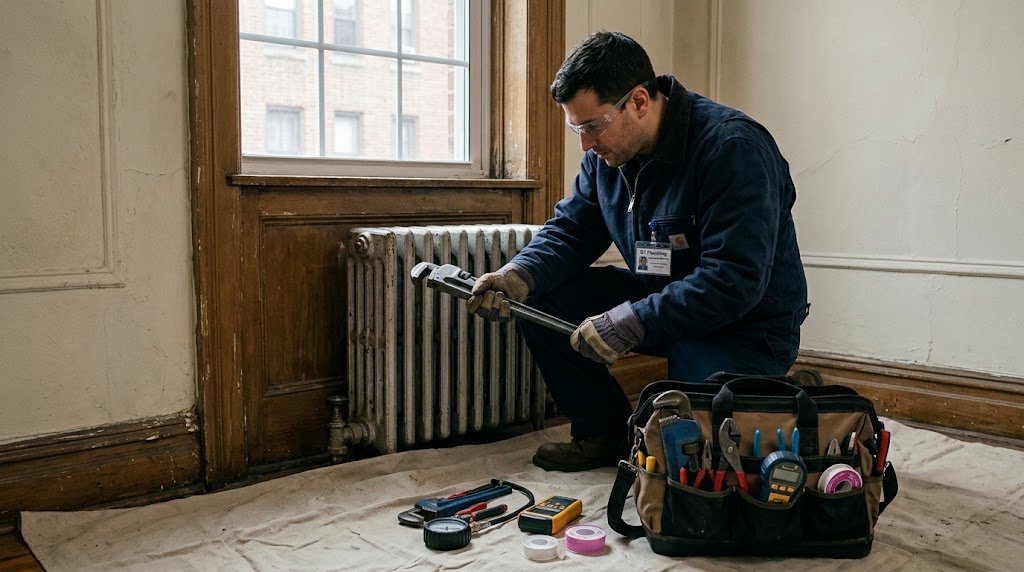
Mastering Steam & Hydronic Heat Dynamics
Cast iron radiators are celebrated for providing gentle, radiant comfort that modern forced-air systems cannot match. However, steam is an unforgiving medium. In Mariners Harbor homes built during the late 19th and early 20th centuries, single-pipe and two-pipe steam systems rely entirely on precise physics: steam must travel through uninsulated mains, displace colder room air through radiator vents, condense into water, and drain smoothly back to the boiler.
When any element in this cycle breaks down, homeowners experience loud metallic banging (water hammer), hissing air vents that spew brown rust water onto hardwood floors, or stubborn cold spots where upper-floor bedrooms receive no warmth at all.
Our heating specialists possess deep practical mastery of steam balance. We replace stuck thermostatic traps, calibrate vent opening thresholds based on piping run length, repack leaking valve stems, and correct radiator pitch to restore whisper-quiet heating performance.
Common Radiator & Steam Heating Faults
Prompt attention to radiator irregularities protects floorboards, reduces boiler fuel consumption, and prevents safety cutoffs:
- Violent Banging (Water Hammer): Caused when high-velocity steam smashes into pooled condensate. Correcting pipe sag or adjusting the wooden shims beneath radiator feet allows condensate to drain freely.
- Leaking Angle Shutoff Valves: Water dripping onto the floor around the valve wheel occurs when stem packing disintegrates. In one-pipe systems, supply valves must remain 100% open or 100% closed; attempting to throttle heat using the valve causes severe flooding and knocking.
- Spitting or Constantly Hissing Air Vents: When internal bi-metal or float mechanisms fail, vents fail to close once steam arrives, dumping moisture and steam into living spaces.
- Cold Radiator with Hot Supply Pipe: Indicates that trapped air cannot escape because the air vent is sealed with mineral corrosion.
- Hydronic Air-Bound Baseboards: In hot water loops, pockets of air block water circulation completely, requiring zone purging and manual bleeder key service.
| Symptom | Underlying Mechanical Cause | Technician Resolution |
|---|---|---|
| Loud clanging during boiler startup | Counterflow condensate trapping or backward radiator slope | Re-pitch radiator toward valve; inspect main branch slope in basement |
| Water pooling at valve base | Dried graphite valve stem packing nut | Disassemble gland and repack with high-temp Teflon/graphite cord |
| Hissing vent releasing steam into room | Defective float disc or calcified vent orifice | Replace with precision-rated Hoffman, Maid-O'-Mist, or Dole air vent |
| Cold lower half of hydronic convector | Low loop water pressure or trapped air bubble | Bleed radiator core, check autofill valve, verify circulator pump pressure |
Frequently Asked Questions
Loud steam pipe hammer occurs when incoming steam collides with accumulated pools of cool water (condensate) trapped inside the pipe or radiator. This usually stems from an improperly pitched radiator, a partially closed supply valve, or a failed steam air vent that cannot discharge air rapidly.
Yes. Most leaks around the valve stem occur when the graphite packing material dries out or loosens. A technician can repack the valve gland with fresh Teflon or graphite packing without disconnecting or replacing the heavy cast iron radiator.
Uneven heating is almost always caused by improper air vent sizing. Radiators closest to the boiler heat first if their vents open too quickly, while distant radiators remain air-bound. Installing matched, adjustable air vents balances steam distribution throughout the home.
In a one-pipe steam system, the radiator must slope slightly downward toward the supply valve (approximately 1/4 inch of fall across the length of the unit) so condensed water drains back into the supply pipe rather than puddling.